
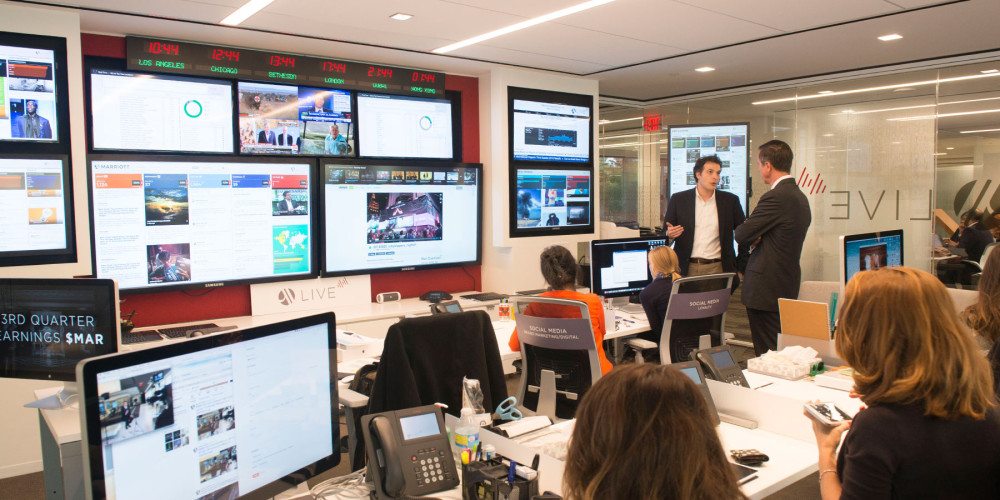
This is the behind the scenes story about how an idea that was born in 2015, during an awkward conversation in an elevator ride, went from a wild concept to winning two Cannes Lions awards in 2017. Plus my top three tips on how to build the social media command center of the future for your brand.
For most of us, riding in elevators is an awkward experience in human interaction.
Lee Gray, an associate dean at the University of North Carolina at Charlotte, is known as the Elevator Guy, and in an NPR podcast, he explained why we “dance” in them.
“Well, I think one of the things that first, to sort of characterize it, is, we’re all accustomed to go into the buildings. We all know buildings are filled with technology. But this is the only piece of technology that looks like a lot of other spaces in the building. In other words, it looks like a room, although it’s a very, very small one. And we all know how we behave in rooms. We give each other an appropriate amount of little, polite, social distance between ourselves. And that’s all fine until we’re in the tiny, tiny room - that’s the elevator. From floor to floor in an elevator is a completely mundane process. And that’s why I think you see, you know, if you’re the only one in the elevator, you sort of stand in the center. And if someone else comes in then you move to a corner, or give yourself an appropriate social distance. And you can watch that dance continue, as you say, as more and more people get in until you have the four corners, then four corners, then some person in the middle, and then that sixth person, then it gets very crowded.” Gray explains.
Understanding the basics of Gray’s explanation, I was really confused by the reaction I received on an elevator ride one day with the VP of Building Operations. We had a meeting scheduled to talk about a vision I had and how I needed to take over a valuable space to make it happen. As we got into the empty elevator from the third floor, I pressed the lobby button and turned to him and said:
“I want to take over a conference room in the lobby and build this thing called a social media brand command center. It’s a centralized location where teams from different groups listen to data and respond with creative in real time.”
He just stared at me in silence. Was it because we were in an elevator? Was I not doing “the dance” the right way? Or was I speaking in marketing jargon?
As the elevator continued down, I tried again and said “Marketing is no longer Monday - Friday, 9 - 5. People and consumers are always on, connected, creating, consuming, and curating content, so our brands should be always on listening and engaging in real time, too. It’s the only way they’ll stay relevant and part of the conversation.
As we got off the elevator, he turned to me and said “OK. I don’t completely understand you, but let me get one thing right at least. You just started here three months ago. We just completed construction on a brand new lobby. You want to walk in and take over a very valuable conference room to build what? A “brand newsroom” I said, again.
This elevator ride happened in 2015, when I left Los Angeles after 15 years in the entertainment industry as a producer to head global creative and content marketing for Marriott International.
Needless to say, my team and I were able to take over the room (with support from very senior executives). With the help of technology vendors and an amazing team, we built what I branded “M Live” in the corporate headquarters of Marriott International. The team and I built three more around the world in London, Miami, and Hong Kong.
“A Brand Command Centers is where data and content come together to create always on marketing along the entire customer journey. They are the heartbeat of consumers and customers.”
They kind of remind me of Lee Gray’s description of the “dance” we as humans do in elevators. These command centers are rooms filled with technology, where we give each other an appropriate amount of social distance between ourselves, respecting different skill sets. Together, we choreograph the “dance” and work in real time together using data and tech to accomplish a common goal: think customer centric and provide value around the clock.
Even though I left Marriott this year to help other brands build content studios and real-time command centers, I’ve watched as the global teams continue to expand the capabilities of M Live and take it even further. I’m most impressed with HYP3R, a geosocial marketing platform (founded by Carlos Garcia) that powers M Live, and engages customers when—and where—it matters most. Check them out.
So I was thrilled to see that M Live, the idea hatched in an elevator just a couple of years ago, was awarded Gold and Silver Creative Data Lions at the Cannes International Festival of Creativity in the categories of Social Data and Use of Real-time Data, respectively.
The command center is the touch point across all 30 of Marriott’s Brands used to identify pop culture trends and create real-time content directly with guests on social channels. Based on live data and metrics, M Live bridges the digital conversation by leveraging its bespoke location-based social platform to initiate surprise and delight moments with our guests while on property through geo-fencing technology.
I hope more brands are inspired by the idea of real-time marketing and the concept of being always on because consumers are.
Here are the top three tips and takeaways if your brand is thinking bout building a social media command center:
- Understand the purpose of it and all the different functions. It’s not just for social media. Other groups can use it too, from corporate and crisis comms to employer brand to investor relations.
- Partner with and select the right vendors from the get go. If you’re going to invest in a brand newsroom, then make sure you choose the right technology to power it. There’s not a one size fits all solution. From hardware to software to furniture, there’s a lot to think about. With the right data and technology, brands can actually do 1:1 real time marketing and provide even more value.
- Hire the right people. I hired all former news producers or journalists to “run and direct” the room day-to-day. When fully staffed, from content producers to data analysts, the rooms have their own energy and really do feel like a “newsroom.”